
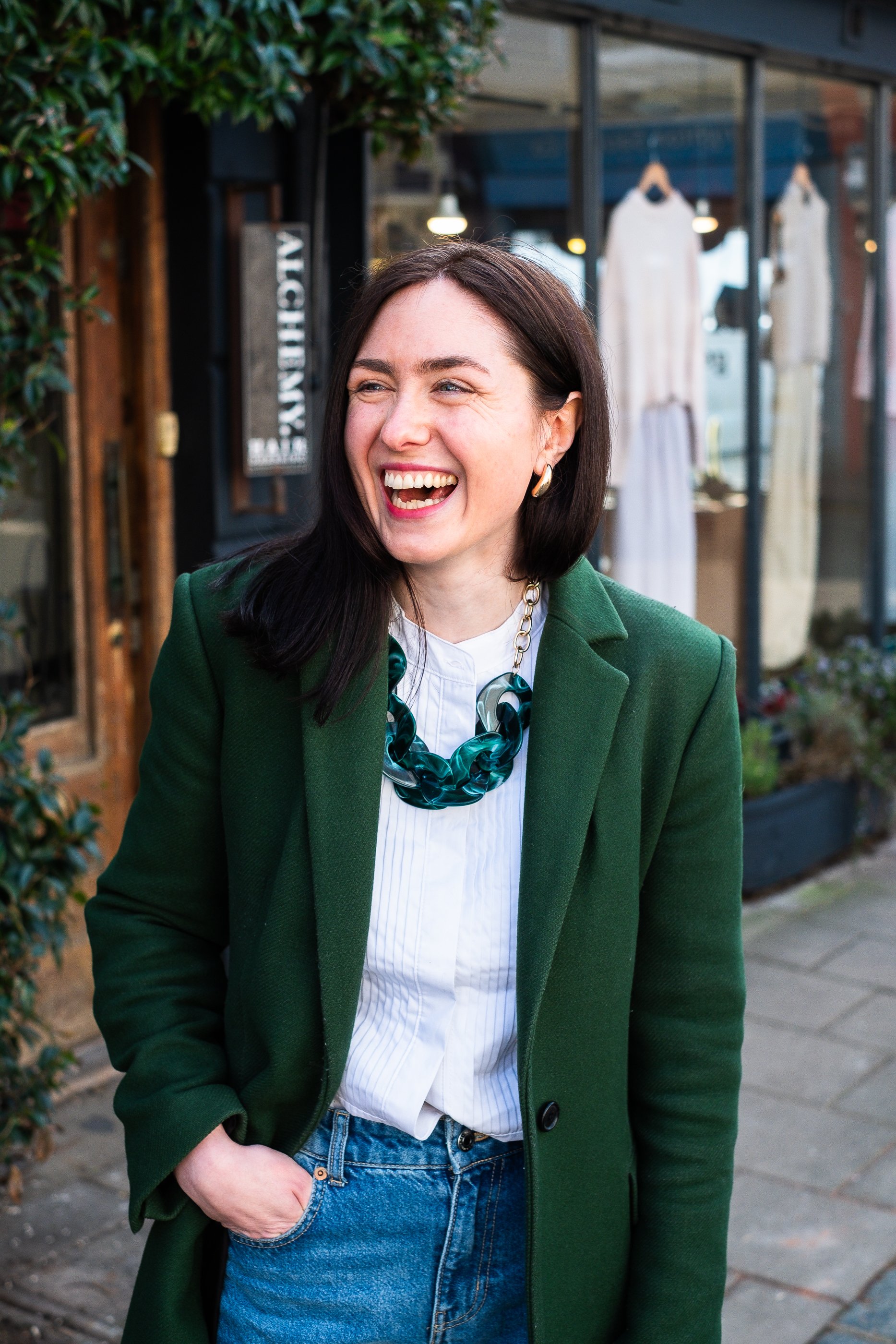
Hi, I’m Sophie Longley.
I know what it's like to finally get the answers you've been searching for — and still feel lost.
When I received my autism diagnosis in 2020 at 28, I walked out of the clinician's office exhausted. Weeks later, I received a report full of deficit language that told me everything I supposedly couldn't do, and almost nothing about who I was or who I could become. I had a label. What I didn't have was a direction.
I'd spent 28 years learning to cope. I didn't want to spend the next 28 doing the same.
So I did something about it.
I went back to university and researched exactly this experience — the strange, disorienting liminal space after a late autism diagnosis. What I found confirmed what I'd felt: this wasn't just my story. The people I spoke with described months, sometimes years, of feeling stuck in between — no longer undiagnosed, but not yet sure what to do with the knowledge. None had received any formal post-diagnostic support. And yet every single one of them didn't just want answers about their past. They wanted to transform their future.
I saw myself in every one of them.
That's what drives my work today.
I'm an autism researcher and coaching psychology practitioner — and I bring a triple lens to everything I do: I live it, I research it, and I practice it. My academic work, published papers, and conference speaking all centre on one thing: changing how the world understands and supports autistic people after diagnosis. That includes working with UK universities to improve diagnostic pathways, and contributing to how neurodiversity coaching is practised and taught across the field.
But more than any of that — I've been where you are.
My approach is built on what I call post-diagnostic becoming: the idea that a late autism diagnosis isn't just something to adjust to, it's a watershed moment with real transformative potential. Under the right conditions, people don't just bounce back — they grow, finding new meaning, deeper self-understanding, and unexpected strengths they never knew they had.
You don't have to keep coping. You get to start becoming.
Whether you're trying to make sense of your diagnosis, reimagine your career as a neurodivergent leader, rebuild your relationships, or simply figure out what thriving actually looks like for you — that's exactly what I'm here for.
My Approach
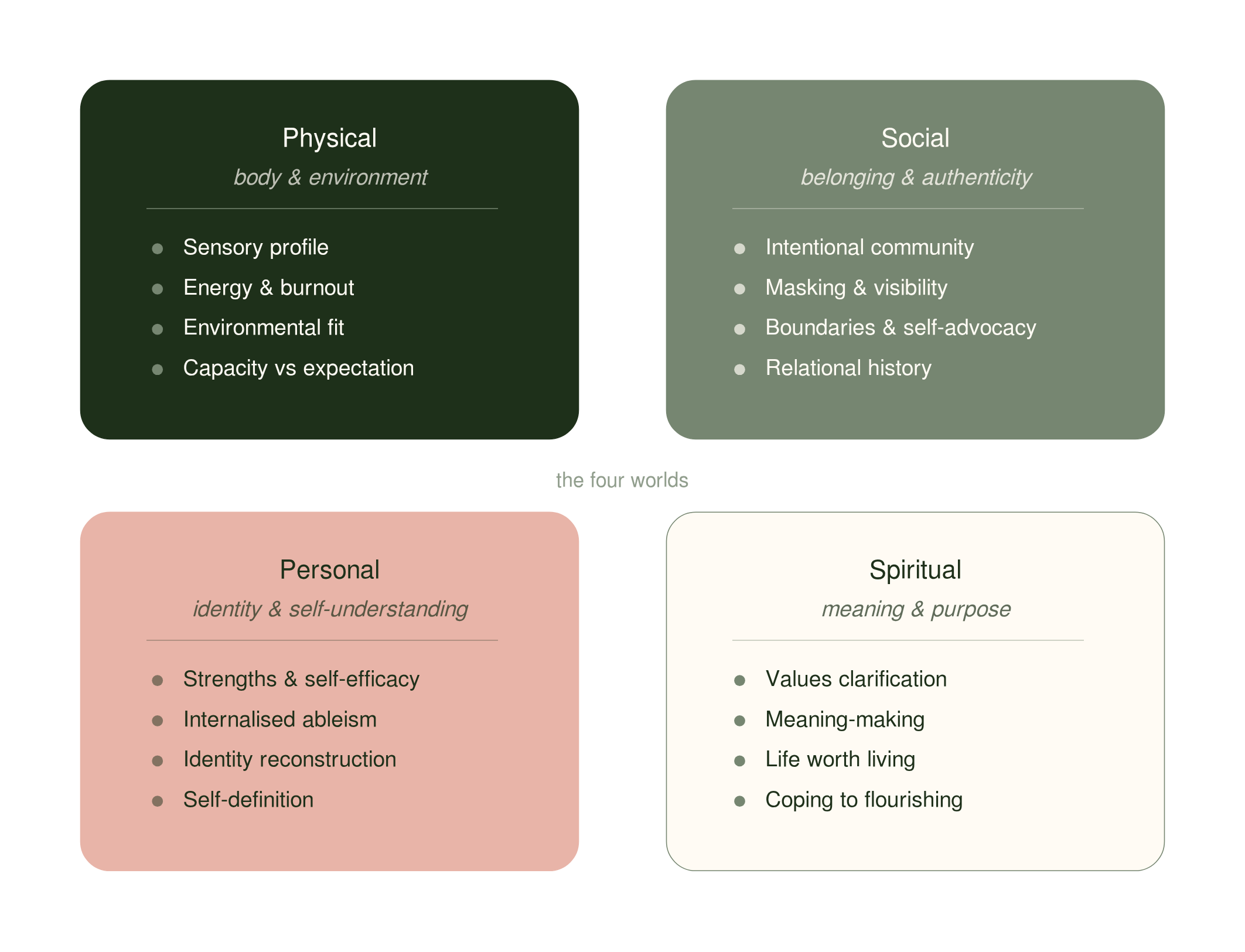
The Four Worlds Model (Van Derzen & Hanaway, 2012), adapted.
My Approach
My work as a coach is deeply shaped by my academic research — and by my own experience as a late-diagnosed autistic woman.
When I researched the experiences of autistic women diagnosed in mid to late adulthood, what they described wasn't a neat process of adjustment or acceptance. It was something far more complex, and far more enduring.
Diagnosis often brings relief and grief at the same time — relief at finally having an explanation, and grief for a past that might have looked very different with earlier recognition. Rather than these feelings resolving over time, many of the women I spoke with described remaining in an in-between state for years, sometimes decades. I call this enduring liminality — a prolonged period of identity reconstruction where grief and relief don't cancel each other out, but coexist. I use the term grelief to hold both at once.
This challenged something I'd long suspected: that diagnosis is not an endpoint. It's often just the beginning of a long, personal process of making sense of who you are and who you want to become.
Why Existential Coaching?
Formal diagnostic and clinical services rarely extend into this longer-term space — and what's needed here isn't treatment. It's support with identity, meaning, choice, and self-understanding.
Existential coaching is particularly well-suited to late diagnosis because it honours uncertainty rather than rushing resolution, makes space for conflicting emotions without pathologising them, and supports identity reconstruction without prescribing who someone should become. It helps people live well within the in-between, rather than forcing closure that isn't ready to come.
The Four Worlds Framework
My coaching is grounded in a model drawn from existential psychology: the Four Worlds. This framework recognises that we each live simultaneously across four dimensions of experience — and that for late-diagnosed autistic adults, each holds its own particular tensions and possibilities.
The Physical World explores the tension between what the world demands and what the neurodivergent body can sustainably offer. We might look at your sensory profile, energy management and burnout prevention, environmental fit, and the gap between your capacity and what's expected of you.
The Social World explores the tension between authenticity and belonging — the lifelong negotiation of masking, visibility, and acceptance. This isn't about learning social skills. It's about becoming more fully yourself in relationship. We might explore what nourishing connection actually looks like for you, boundaries, self-advocacy, and what it means to be seen.
The Personal World explores the tension between who you were told you were and who you now understand yourself to be. This is where we do identity work — unpicking internalised ableism and self-blame, rebuilding self-understanding after diagnosis, and integrating your autistic self with everything that came before.
The Spiritual World explores the tension between freedom and responsibility, and the search for meaning after a late diagnosis. This is where we clarify your values, explore what a life worth living actually looks like for you, and begin the shift from coping to something that feels more like becoming.
What This Looks Like in Practice
This isn't about fixing you or moving you toward a predefined endpoint. It's about creating space for reflection, authorship, and genuine choice — on your terms, at your pace.
You don't need to have resolved everything to begin living differently. My role is to walk alongside you as you make sense of what this diagnosis means for you, now and into the future.