my Coaching Model
Why most post-diagnostic support gets it wrong
Most approaches to support after a later in life autism diagnosis assume the goal is to help you "adjust". To move from confusion toward acceptance, from grief toward relief, until you land somewhere settled.
My own research, conducted with late-diagnosed autistic women, found something different. Grief and relief don't resolve into each other over time. They coexist; sometimes for decades. One woman I spoke with, diagnosed over twenty years earlier, still described feeling "free and trapped at the same time." Another invented a word for it on the spot: "grelief."
I call this enduring liminality: a state of being between your former and emerging identity that doesn't necessarily end, and isn't a sign that something's gone wrong. It's a normal, ongoing part of making sense of who you are after diagnosis.
This shapes everything about how I coach.
What this means in practice
I don't work toward "resolution" as the goal. I won't rush you toward feeling settled, or treat lingering grief as something to fix before you're allowed to feel relief, or vice versa. Both can be true at once. That's not a problem to solve, it's something to be held.
I'm also not here to interpret your diagnosis for you clinically, or tell you what it should mean. I'm a discovery partner: someone who helps you work out what your diagnosis means to you, at whatever pace and in whatever shape that takes.
Existential coaching: a method built for paradox
My coaching is grounded in existential coaching: an approach concerned with meaning, identity, freedom, and how you choose to live, rather than fixing problems or optimising performance. It doesn't ask you to resolve contradictions; it gives you space to sit with them, examine them, and decide what to do next regardless.
The Four Worlds: a practical framework
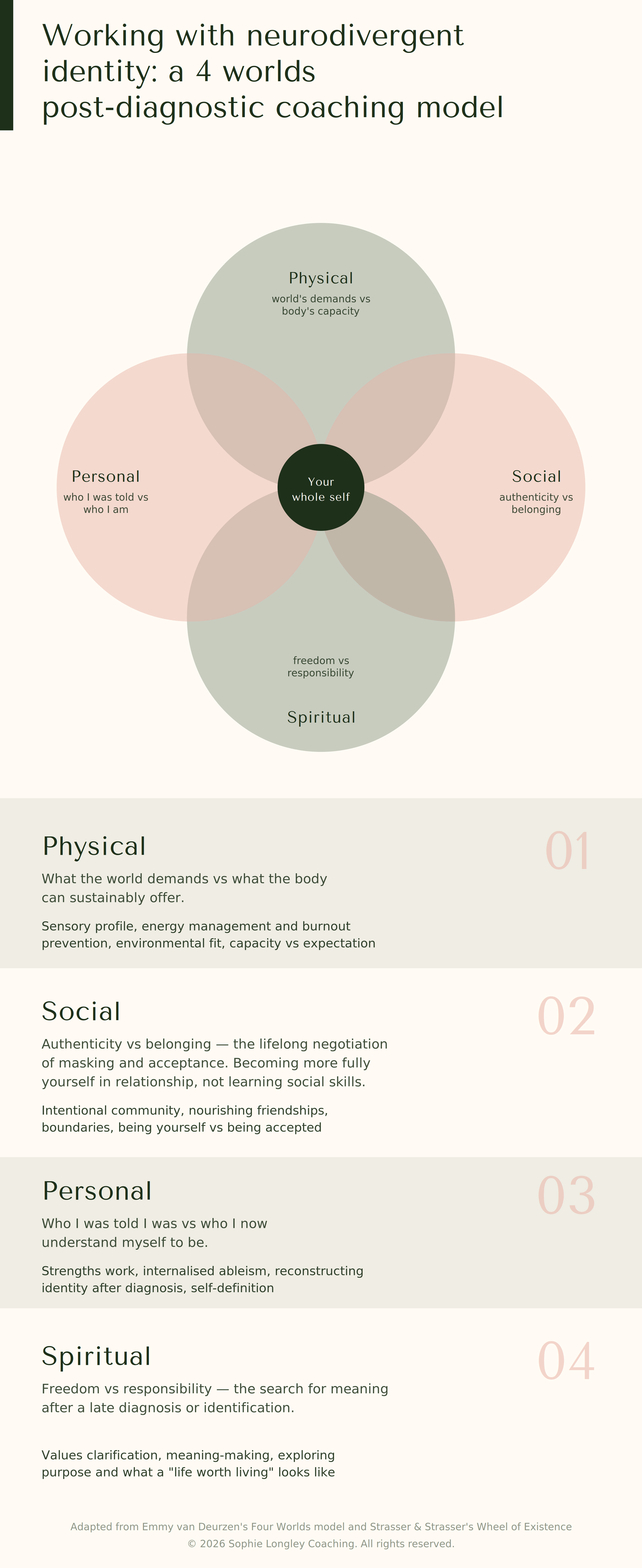
In sessions, I draw on a model I've developed for neurodivergent identity after diagnosis, mapping four dimensions of experience, each holding its own tension:
Physical: what the world demands vs. what your body can sustainably offer
Social: authenticity vs. belonging
Personal: who you were told you were vs. who you understand yourself to be
Spiritual: freedom vs. responsibility, and what a life worth living looks like
At the centre of all four: is your whole self, not a diagnosis to manage, but a person to understand.
Background
I hold an MSc in Psychology and am a trained existential coach with the New School of Psychotherapy and Counselling. As a late-diagnosed autistic woman myself, I bring both professional grounding and lived experience to this work. Read more about my research.