
My Research
The study
I conducted formal research into the experiences of late-diagnosed autistic women, using Interpretative Phenomenological Analysis (IPA), a qualitative method suited to capturing detailed, idiographic accounts of lived experience.
Five women diagnosed as autistic between the ages of 30 and 71 were interviewed, with analysis conducted at both an individual and group level to identify shared experiential themes.
This research was conducted as part of my MSc at the University of Sussex and is currently pre-submission for peer review; it has not yet been published or independently peer-reviewed.
Key findings
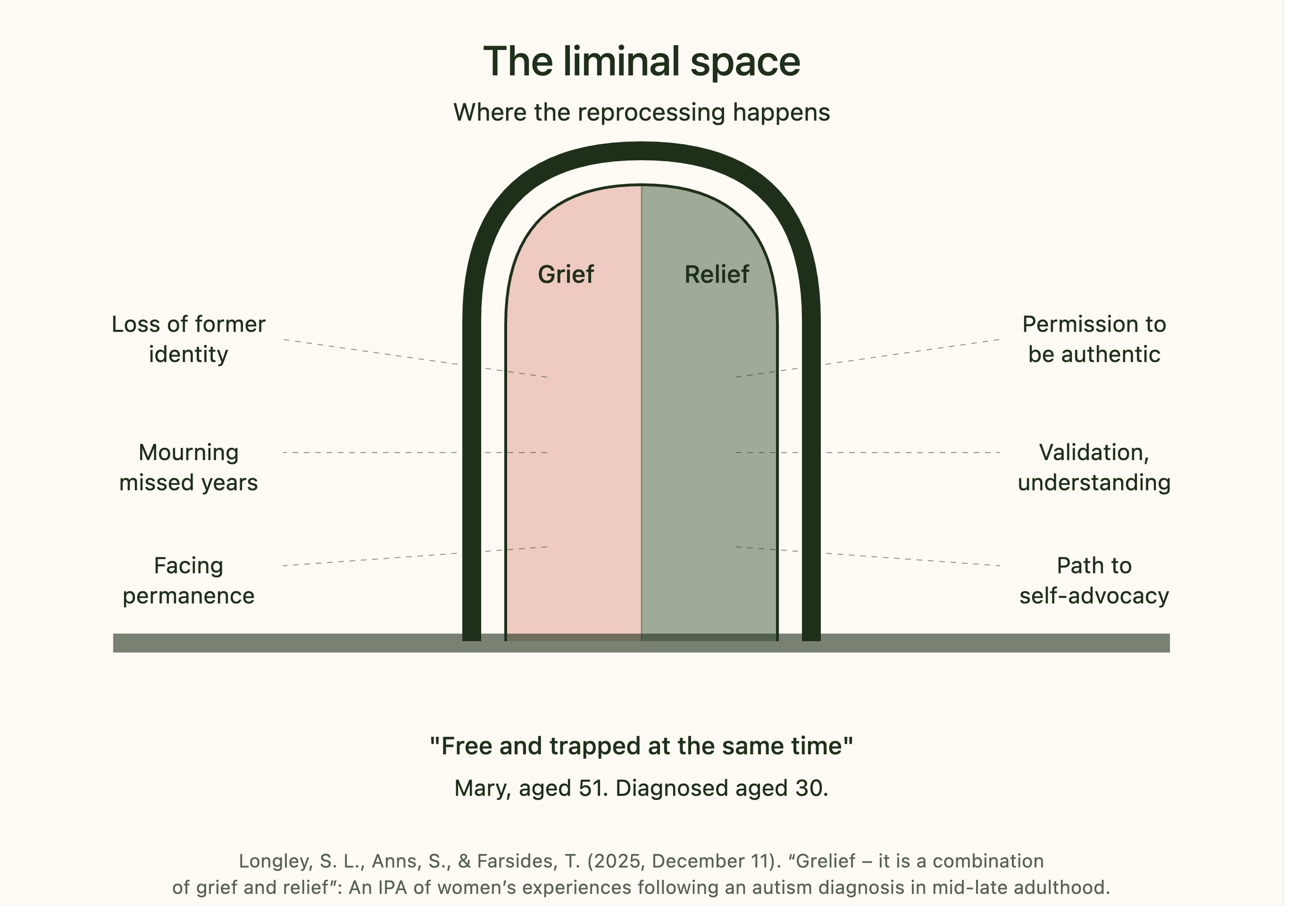
Three themes emerged: Identity Grief and Missed Opportunities, Relief as Permission and Empowerment, and Living in the Liminal Space.
The central finding: participants did not move through grief toward relief, or oscillate between the two, as existing models of adjustment (e.g. Stroebe & Schut's Dual Process Model) might predict. Instead, they described simultaneously inhabiting both states, sometimes for over twenty years post-diagnosis. Drawing on Turner's (1969) concept of liminality, this research proposes that a later-in-life autism diagnosis creates an enduring liminal identity position, rather than a transitional phase that resolves with adjustment or acceptance.
This diverges from Turner's original framework, in which liminal states are temporary, and extends prior work on autism diagnosis and grief (Leedham et al., 2020) by showing these emotions coexist rather than occur separately.
The research also reframes post-diagnostic relief as a function of permission, medical, social, and self-authorisation to stop performing neurotypicality, rather than simply relief from gaining an explanation.
The Four Worlds model: scope & status
The Four Worlds framework I use in coaching practice is my own applied synthesis. It draws on two established frameworks, Emmy van Deurzen's Four Worlds and Strasser & Strasser's Wheel of Existence, adapted specifically for neurodivergent identity after diagnosis, and shaped by what my research surfaced.
This adaptation has not itself been independently validated or peer-reviewed. It reflects my own practitioner synthesis of peer-reviewed existential theory and my research findings, applied in my coaching practice, not a separately tested or published model.
Limitations
This was a small, idiographic study (n=5), consistent with IPA's emphasis on depth over generalisability. Participants were self-selected, autistic, and connected enough to their identity to discuss it openly, the findings may not reflect the experiences of women disconnected from an autistic identity, those affected by stigma or shame, or autistic men, non-binary people, or people from other demographic or cultural backgrounds. As with all IPA research, findings are not intended to generalise, and readers should judge relevance to their own context.
You can access a pre-print of the research paper here
References
Leedham, A., Thompson, A. R., Smith, R., & Freeth, M. (2020). 'I was exhausted trying to figure it out': The experiences of females receiving an autism diagnosis in middle to late adulthood. Autism, 24(1), 135–146.
Stroebe, M., & Schut, H. (1999). The dual process model of coping with bereavement: Rationale and description. Death Studies, 23(3), 197–224.
Turner, V. (1969). Liminality and communitas. In The Ritual Process: Structure and Anti-Structure (pp. 94–130). Aldine Publishing.
Van Deurzen, E. (2010). Everyday mysteries: A handbook of existential psychotherapy (2nd ed.). Routledge.
Strasser, F., & Strasser, A. (1997). Existential time-limited therapy: The wheel of existence. Wiley.